Saturday, 22 October (updated 28 October)
I started with a recipe for Sweet Potato Bread that I found in the latest catalogue from Penzeys spices (sorry, can't find it on their website). My baking philosophy is that a recipe is a starting point, and you make it work with what you have. I had some cooked pumpkin on hand, and it seemed easier to use that than to cook a sweet potato. I modified the original recipe by cutting the amount of sugar in half and cutting back on the oil (I find you need less fat with GF flours). My measurements were not very precise, and I didn’t add any xanthan gum, and it came out fine. It doesn't rise a lot, but judging from the picture with the original recipe, the gluten-ful version didn't either. Pumpkin and sweet potatoes are heavy stuff.
Here’s my approximate recipe for GF Pumpkin Bread.
1 cup brown rice flour
¾ cup white rice flour
¼ cup oat flour
[other flours and flour proportions would work too; I’d stay away from the starches—the pumpkin needs something substantial to absorb the moisture]
¾ cup brown sugar
[less sugar would be OK, or maybe a little molasses and a little sugar]
½ tsp baking soda
½ tsp baking powder
½ tsp salt
1/2 tsp each cinnamon, nutmeg, and ginger (or to taste)
1 cup cooked pumpkin (make your own or use canned)
2 eggs
1/3 cup vegetable oil
1/3 cup water
Preheat oven to 350. Combine the dry ingredients in a large bowl; mix well with a whisk (to get everything evenly distributed and to break up the clumpy oat flour). In a small bowl, mash up the pumpkin and add the eggs, oil, and water. Mix this until smooth, then stir the mixture into the dry ingredients just until moistened. Spoon it all into a greased 9x5 inch loaf pan. Bake for 50-60 minutes or until it passes the toothpick test. Let the loaf cool in the pan for 10 minutes before turning it onto a wire rack, then let it cool to room temperature before you try to slice it.
If you don't like plain pumpkin bread, the original recipe calls for sprinkling vanilla sugar over the top before you bake the loaf. Or you could add icing before slicing. Or add some mini chocolate chips or toasted walnuts or raisins to the batter. Or carefully spread Nutella on individual slices.
Saturday, October 22, 2011

Tuesday, June 21, 2011
Another Elkhorn race report
Tuesday, 21 June
 It was a great weekend at the tenth edition of the Elkhorn Classic. There is so much to love about this race. It’s challenging. It’s rewarding. It’s beautiful. You make new friends and are reunited with old ones. It’s a city girl’s chance to hang in a friendly small town. Highlights for me this year:
New discovery. It took 10 years of thinking Sunday’s road stage was 118 miles out in the middle of nowhere, but this year I discovered that there is a CAFÉ halfway through the race. It’s making me rethink my strategy for next year. Coffee and pie might hit the spot after the first feed zone: unless you want to vie for that coveted 12th place in GC, what’s the difference between being 15 minutes and 30 minutes down? There will still be beer and pizza for you at the finish—and there will still be men stragglers on the course behind you. :)
Nature breaks. In Friday’s road race, it took the women’s peloton about 3 miles of talking and waving to organize a pee stop. Best comment: “Don’t tell Candi. We’ll all get flamed on OBRA chat!” In Sunday’s road race, the cat 1-2 men passed me as they were trying to take a nature break. Some appeared to get stage fright with me hanging off the back of their bunch (I hid behind the follow car—out of sight and no chance of any downwind drift). Some had to stop, some nearly ran into the ditch as they tried to go while riding on the edge of the pack. Kept me distracted from my solo pity party at that stage.
Ego. I think my GC finish this year was tied for my highest place ever at Elkhorn. I was also DFL, so it wasn’t much of an ego boost. But I forget that on the way to and from this race, I pass by a stage race prologue course where I still hold the women’s course record. I won by one second. Happy memories every time.
In-race entertainment. In Friday’s road race (after the pee stop), one woman rode off the front of the pack on the descent into Union. She had about 300 meters on us coming up to the second of two turns on the entire 73-mile course. A man in a wheelchair rolled out into the crosswalk. The lead car had to stop. The rider had to stop. What’re ya gonna do? Her team then proceeded to hammer away at the front of the bunch (there were a sum total of 20 women in the race this year) while one of their members tried to deal with a mechanical at the back of the bunch and got dropped, never to catch back on.
Memories: When you’ve been at a race 10 times and in it 9 times, you are distracted by memories of people you’ve raced with and accumulated race highlights. When stage 1 and stage 4 were run in the opposite directions. When it snowed. When the TT course ran straight out to the Elkhorn range. When the NZ women’s team showed up on their way to the HP Women’s Challenge, shattered the field on the first climb on the last day, and then DNFed at mile 18 because they didn’t want to ride that far right before HP, leaving the rest of us in onesies and twosies for the remaining 80-some miles. Riding in cattle drives on stage 4. Climbing Dooley Mountain with women who’ve never ridden 100 miles in their lives and surprise themselves by making it up that final climb. (I’m still trying to block the memories of the year we rode down to Hell’s Canyon in horrible heat on a substitute course because of road work.)
Baker City peeps. It is quite amazing to ride your bike 50 miles into the Oregon mountains, come to an intersection, and discover two friendly corner marshalls stopping traffic so that you can roll through a stop sign. Lead and follow cars are staffed by devoted local supporters. The crits (when not cancelled because of rain) are loaded with more primes than there are laps in each race. The people in every feed zone, all 20 of them urging you to take THEIR bottle (but I only have two bottle cages….) and no miffed hand-ups. And all the businesses that welcome riders (they know who you are when you walk in the door) and ask how the race is going.
Going solo. I was flying solo at the race this year because Mick was off jousting with other windmills at Race Across the West. But it is such an easy race in terms of logistics, and many people generously “looked after” me. And they are some of the ones I will remember while I’m racing out there next year!
 It was a great weekend at the tenth edition of the Elkhorn Classic. There is so much to love about this race. It’s challenging. It’s rewarding. It’s beautiful. You make new friends and are reunited with old ones. It’s a city girl’s chance to hang in a friendly small town. Highlights for me this year:
New discovery. It took 10 years of thinking Sunday’s road stage was 118 miles out in the middle of nowhere, but this year I discovered that there is a CAFÉ halfway through the race. It’s making me rethink my strategy for next year. Coffee and pie might hit the spot after the first feed zone: unless you want to vie for that coveted 12th place in GC, what’s the difference between being 15 minutes and 30 minutes down? There will still be beer and pizza for you at the finish—and there will still be men stragglers on the course behind you. :)
Nature breaks. In Friday’s road race, it took the women’s peloton about 3 miles of talking and waving to organize a pee stop. Best comment: “Don’t tell Candi. We’ll all get flamed on OBRA chat!” In Sunday’s road race, the cat 1-2 men passed me as they were trying to take a nature break. Some appeared to get stage fright with me hanging off the back of their bunch (I hid behind the follow car—out of sight and no chance of any downwind drift). Some had to stop, some nearly ran into the ditch as they tried to go while riding on the edge of the pack. Kept me distracted from my solo pity party at that stage.
Ego. I think my GC finish this year was tied for my highest place ever at Elkhorn. I was also DFL, so it wasn’t much of an ego boost. But I forget that on the way to and from this race, I pass by a stage race prologue course where I still hold the women’s course record. I won by one second. Happy memories every time.
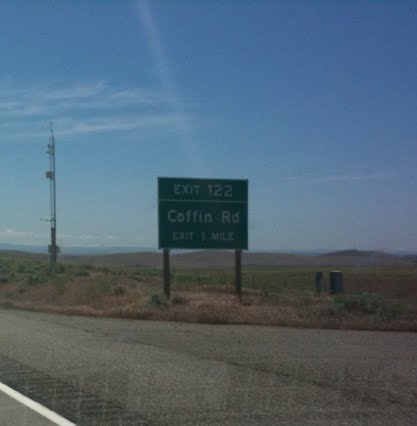
In-race entertainment. In Friday’s road race (after the pee stop), one woman rode off the front of the pack on the descent into Union. She had about 300 meters on us coming up to the second of two turns on the entire 73-mile course. A man in a wheelchair rolled out into the crosswalk. The lead car had to stop. The rider had to stop. What’re ya gonna do? Her team then proceeded to hammer away at the front of the bunch (there were a sum total of 20 women in the race this year) while one of their members tried to deal with a mechanical at the back of the bunch and got dropped, never to catch back on.
Memories: When you’ve been at a race 10 times and in it 9 times, you are distracted by memories of people you’ve raced with and accumulated race highlights. When stage 1 and stage 4 were run in the opposite directions. When it snowed. When the TT course ran straight out to the Elkhorn range. When the NZ women’s team showed up on their way to the HP Women’s Challenge, shattered the field on the first climb on the last day, and then DNFed at mile 18 because they didn’t want to ride that far right before HP, leaving the rest of us in onesies and twosies for the remaining 80-some miles. Riding in cattle drives on stage 4. Climbing Dooley Mountain with women who’ve never ridden 100 miles in their lives and surprise themselves by making it up that final climb. (I’m still trying to block the memories of the year we rode down to Hell’s Canyon in horrible heat on a substitute course because of road work.)
Baker City peeps. It is quite amazing to ride your bike 50 miles into the Oregon mountains, come to an intersection, and discover two friendly corner marshalls stopping traffic so that you can roll through a stop sign. Lead and follow cars are staffed by devoted local supporters. The crits (when not cancelled because of rain) are loaded with more primes than there are laps in each race. The people in every feed zone, all 20 of them urging you to take THEIR bottle (but I only have two bottle cages….) and no miffed hand-ups. And all the businesses that welcome riders (they know who you are when you walk in the door) and ask how the race is going.
Going solo. I was flying solo at the race this year because Mick was off jousting with other windmills at Race Across the West. But it is such an easy race in terms of logistics, and many people generously “looked after” me. And they are some of the ones I will remember while I’m racing out there next year!
Wednesday, June 01, 2011
HT*U Part One
Wednesday, 1 June
I vowed not to be a wuss or to whine too much about the unpleasantness forecast for last Saturday’s Lewis and Clark 12/24 hour race. That made things hard before I even got on the bike. A tornado touched down on Friday evening not far from the race start, and the forecast for Saturday included rain and snow above 2,500 feet (the race tops out on Old Man Pass above 3,000 feet) and thunderstorms with hail in the afternoon in the lowlands. Yummy race conditions—not.
There’s no boy scout in me, but I went into this as prepared as I could. Toe warmers between my shoes and shoe covers, one pair of dry gloves in my pocket and another pair waiting for me at each of the time stations, dry rain jacket at each time station and dry everything at TS 2 at the top of the pass. Prep for my previous 12-hour events has mostly focused on food, but this one was all about trying to stay warm; staying dry was apparently out of the question.
Yes, it was raining at the start so it was full-on HTFU from the get-go. The first few miles are up and down, and I caught and passed several riders. A group of recreational riders going the opposite direction included someone who recognized me, and during our mutual greetings of “hi,” I missed the route marker painted on the road and thus missed a turn. But so did the rider in front of me, whom I continued to chase until the road came to a dead end. We turned around and got back on course; some folks were more than a little surprised when I passed them for the second time in three miles.
I’ve raced this part of the course four times now, so I didn’t have to have the cue sheet in hand, and I recognized most of the turns (apart from the one I missed). After a beautiful stretch along the Washougal River, the route eventually comes to the Columbia River Gorge and a busy highway. Most traffic was polite, but one tractor-trailer fully loaded with plywood did not move over an inch. Thankfully, this was a section where the shoulder was 3 feet instead of 6 inches. Time Station 1 is at the Bridge of the Gods, and it looked very Wagnerian with the fog and mist in the hills and on the river (and a tailwind, gentle by Gorge standards). I had already planned to simply roll through the time station, but I snagged three cookies before hitting the road again.
From that point until I reached the end of the big loop back in Hockinson 100 miles later, I saw just one other racer. I had already passed all the other women in the 12-hour race. It was hard to stay motivated without anyone on my radar, but there were other things to keep me occupied. An elk came out on the road and blocked my path (I had not HTFUed enough to play chicken with something that big!). There was a timed KOM section up the steepest part of Old Man Pass; the time keeper at the bottom was ringing his cowbell so hard that I couldn’t ask if there was anyone ahead of me to chase or how far to the top. Who would have thought: too much cowbell!
Time Station 2 at the summit was a full stop to stock up on food and water and to swap some of my soggy clothes for warm, dry layers (no snow falling up there, just sunshine!). Gotta love stripping off half your clothes by the side of the road at the top of a mountain. The first few miles down the north side were between four-foot snowbanks on either side of the road, and I was so happy for my dry clothes and heavy winter raincoat and toasty toes, especially when I rode into a shower. I thought there was no way I would see Mt. St. Helens through the clouds and rain, but being wrong is good sometimes! In the first glimpse, clouds obscured the top of the mountain. But then I remembered that mountain has no top! From a lower elevation farther down the descent, the complete view was breathtaking: the all-white peak so close you could count the trees on its lower slopes. This view is worth the price of admission (in dollars and effort) to this race. It was all I could do not to stop and gawk! (I did stop here to take pictures the first time I did this race.)
The race winds downhill through forest and then continues along a reservoir to the town of Cougar and Time Station 3, and the headwind along this stretch was demoralizing although not demonic. The best food discovery this year was mini bagels with PB and marmalade. Fix one to-go and eat it as you roll out. There is a drawback to this eating plan, however. After TS 2, the marmalade oozed onto my gloves. Licking my gloves was a little gross if I thought about it too much, so at TS 3, I took off my right glove before I started eating. Then I managed to get marmalade on my brake hood. No, I did not try to lick that off!
More short climbs and small towns and a bunch of RR tracks, and eventually you’re back at the start/finish in Hockinson to tackle the short loop to fill out your 12 hours (or 24). Going so long without seeing another racer left me feeling complacent about the whole race thing. I was ready to climb off and be done at the end of the 140-mile big loop, or at least to stop at the finish line and ask how far back my competition was in order to figure out how much farther I needed to go to win. But that didn’t seem very sports(wo?)manlike and perhaps an insult to the promoter (I won’t try my best), so I didn’t. Funny, though, seeing more racers on the first lap of the short loop unconsciously got me back into a more competitive mode; I set a goal and worked really hard to ride steady so that I would meet it (I missed by 2 miles—I dropped my chain about 6 miles from the end and that broke my focus).
My total distance for the 12 hours was 177 miles (not counting the extra mile I rode off course just after the start). Certainly not my best effort on this course, but better than the 0 miles I was afraid the weather would bring me to. Not seeing other racers—or their always-cheerful support crews—gave the race the feel of a touring ride for almost 100 miles. But the competitive drive and social interaction as I passed other racers or they passed me made the last few hours fun—in a really perverse way.
There’s no boy scout in me, but I went into this as prepared as I could. Toe warmers between my shoes and shoe covers, one pair of dry gloves in my pocket and another pair waiting for me at each of the time stations, dry rain jacket at each time station and dry everything at TS 2 at the top of the pass. Prep for my previous 12-hour events has mostly focused on food, but this one was all about trying to stay warm; staying dry was apparently out of the question.
Yes, it was raining at the start so it was full-on HTFU from the get-go. The first few miles are up and down, and I caught and passed several riders. A group of recreational riders going the opposite direction included someone who recognized me, and during our mutual greetings of “hi,” I missed the route marker painted on the road and thus missed a turn. But so did the rider in front of me, whom I continued to chase until the road came to a dead end. We turned around and got back on course; some folks were more than a little surprised when I passed them for the second time in three miles.
I’ve raced this part of the course four times now, so I didn’t have to have the cue sheet in hand, and I recognized most of the turns (apart from the one I missed). After a beautiful stretch along the Washougal River, the route eventually comes to the Columbia River Gorge and a busy highway. Most traffic was polite, but one tractor-trailer fully loaded with plywood did not move over an inch. Thankfully, this was a section where the shoulder was 3 feet instead of 6 inches. Time Station 1 is at the Bridge of the Gods, and it looked very Wagnerian with the fog and mist in the hills and on the river (and a tailwind, gentle by Gorge standards). I had already planned to simply roll through the time station, but I snagged three cookies before hitting the road again.
From that point until I reached the end of the big loop back in Hockinson 100 miles later, I saw just one other racer. I had already passed all the other women in the 12-hour race. It was hard to stay motivated without anyone on my radar, but there were other things to keep me occupied. An elk came out on the road and blocked my path (I had not HTFUed enough to play chicken with something that big!). There was a timed KOM section up the steepest part of Old Man Pass; the time keeper at the bottom was ringing his cowbell so hard that I couldn’t ask if there was anyone ahead of me to chase or how far to the top. Who would have thought: too much cowbell!
Time Station 2 at the summit was a full stop to stock up on food and water and to swap some of my soggy clothes for warm, dry layers (no snow falling up there, just sunshine!). Gotta love stripping off half your clothes by the side of the road at the top of a mountain. The first few miles down the north side were between four-foot snowbanks on either side of the road, and I was so happy for my dry clothes and heavy winter raincoat and toasty toes, especially when I rode into a shower. I thought there was no way I would see Mt. St. Helens through the clouds and rain, but being wrong is good sometimes! In the first glimpse, clouds obscured the top of the mountain. But then I remembered that mountain has no top! From a lower elevation farther down the descent, the complete view was breathtaking: the all-white peak so close you could count the trees on its lower slopes. This view is worth the price of admission (in dollars and effort) to this race. It was all I could do not to stop and gawk! (I did stop here to take pictures the first time I did this race.)
The race winds downhill through forest and then continues along a reservoir to the town of Cougar and Time Station 3, and the headwind along this stretch was demoralizing although not demonic. The best food discovery this year was mini bagels with PB and marmalade. Fix one to-go and eat it as you roll out. There is a drawback to this eating plan, however. After TS 2, the marmalade oozed onto my gloves. Licking my gloves was a little gross if I thought about it too much, so at TS 3, I took off my right glove before I started eating. Then I managed to get marmalade on my brake hood. No, I did not try to lick that off!
More short climbs and small towns and a bunch of RR tracks, and eventually you’re back at the start/finish in Hockinson to tackle the short loop to fill out your 12 hours (or 24). Going so long without seeing another racer left me feeling complacent about the whole race thing. I was ready to climb off and be done at the end of the 140-mile big loop, or at least to stop at the finish line and ask how far back my competition was in order to figure out how much farther I needed to go to win. But that didn’t seem very sports(wo?)manlike and perhaps an insult to the promoter (I won’t try my best), so I didn’t. Funny, though, seeing more racers on the first lap of the short loop unconsciously got me back into a more competitive mode; I set a goal and worked really hard to ride steady so that I would meet it (I missed by 2 miles—I dropped my chain about 6 miles from the end and that broke my focus).
My total distance for the 12 hours was 177 miles (not counting the extra mile I rode off course just after the start). Certainly not my best effort on this course, but better than the 0 miles I was afraid the weather would bring me to. Not seeing other racers—or their always-cheerful support crews—gave the race the feel of a touring ride for almost 100 miles. But the competitive drive and social interaction as I passed other racers or they passed me made the last few hours fun—in a really perverse way.
Monday, January 24, 2011
But will it work?
Monday, 24 January
 Many times on my way home from work I think up the perfect meal plan, only to be foiled by some key ingredient I know I'm missing. I could stop at a regular supermarket, but I don't carry a bike lock with me and I'm reluctant to leave my dirty, fendered, heavy commuter bike unprotected for even a few minutes. A drive-thru grocery store could be perfect. Unfortunately, this one doesn't seem to carry the sort of thing that's likely to be missing from my pantry; I'm usually looking for veggies or rice or GF pasta. Maybe their inventory will expand or shift based on demand?
Picking up from a thread of comments on a recent Facebook post here:
There's a relatively new business establishment along my commute route. It's an interesting concept, and I'd like to think that it might work: drive-thru grocery store.
 Many times on my way home from work I think up the perfect meal plan, only to be foiled by some key ingredient I know I'm missing. I could stop at a regular supermarket, but I don't carry a bike lock with me and I'm reluctant to leave my dirty, fendered, heavy commuter bike unprotected for even a few minutes. A drive-thru grocery store could be perfect. Unfortunately, this one doesn't seem to carry the sort of thing that's likely to be missing from my pantry; I'm usually looking for veggies or rice or GF pasta. Maybe their inventory will expand or shift based on demand?
I'm hoping for a chance to visit this place. Also unfortunately, it's on a state highway, and in this particular stretch there is no bus lane, no bike lane, and no shoulder. But I'll try to get there and follow up with info on what price you pay for this convenience. I see they're looking to set up franchises, so you could bring one to your neighborhood too!
Friday, December 31, 2010
Meaningless data for 2010
New Year's Eve
Jennifer recently wondered “why do rides seem so meaningless when your powertap doesn’t work?” I feared that my miles for the year were therefore all meaningless since I have none of the data that a powertap captures for any of my excessive miles. Z, however, reminded me I am just as fixated by the numbers I generate at the end of each year as Jennifer is by the display that mesmerizes her for every inch she travels on a bike. True enough, although I prefer to think of my habit in a category I heard described on the radio today: the need to make lists at the end of the year. Maybe it’s a way of proving to myself that the last 365 days were not without meaning or merit or some sort of accomplishment.
What I really meant in response to Jen’s question was that every mile on a bicycle should be meaningful with or without data, even if you don’t know that it was a mile you just traveled or 300 seconds of your life that it consumed. My most memorable moments on a bike in 2010 were these:
Riding along the John Day River with Mick and Terri on a May afternoon. The temperature was perfect, we were all the traffic there was, the river is always beautiful, the riding was easy on the legs, and it was all just incredibly peaceful.
Riding the long climb up from Clarno (located elsewhere on the John Day) on the tandem with Mick. Again, there was no traffic, you feel like you’re climbing up the side of the world with views to everywhere—and there was Christy Moore on my iPhone to keep us moving along.
Riding from Newhalem to Mazama and back. I just don’t get tired of that ride or those views. I made the trip 5 times this year. I passed someone walking his bike, I passed someone who was riding so slowly I thought he would tip over onto his paniers, I just missed the boulder the size of a house falling into the roadway, and I reveled in all 120 miles every single time. And I found a quarter on the shoulder of the road on 3 of the trips, and on the last trip I found decals for the letters M and W (like you'd put on your driveway signpost) on the shoulder--just those 2, no other letters.
Hearing a lot of gunfire as I approached the turnaround at the WA State TT Championship. Even in my oxygen-deprived state, it was unnerving, to say the least. Seems the locals were getting in some target practice. There was also that horrific downpour in the last 10K of the Ravensdale Road Race where you could not see the road in front of you. The finish line was about the bleakest and loneliest I've ever seen.
Really, though, the most memorable moment was the day and a half of watching my husband get to the Race Across Oregon finish powered solely by determination. The heat took its toll on the Irish lad, and his stomach rebelled (over and over again), so the last 200 miles were fueled by willpower alone.
So here’s the data for my year in review:
Total bike miles on the road: 13,012 (2009: 12,333; 2008: 12,693).
Month with the most miles: January 1,383. (My biggest month in 2009 was May, with 1,653 miles; May was No. 2 in 2010, with 1,336.)
Month with least miles: November again, with 671 (down from last year’s low of 757).
19 rides of 100 miles or more, up from 16 in 2009. Longest rides were 193, 181 (tandem), 144, and 136 miles.
First day in the year that I did not ride my bike: May 30 (that tells you something about the mild winter we had). Also missed 3 days while crewing for my husband at RAO, 2 days in the snowpocalypse in November, plus 9 more days. So 15 days of no cycling out of 365. (The figure was 29 in both 2009 and 2008.)
Most miles in one week (7 days): 451 (down from 599 in 2009).
Number of times I rode a trainer: 106. That’s up from just 9 in 2009. Different training program. I thought I would learn to spin more on the road, but I think I just do all my spinning now on the trainer.
Jennifer recently wondered “why do rides seem so meaningless when your powertap doesn’t work?” I feared that my miles for the year were therefore all meaningless since I have none of the data that a powertap captures for any of my excessive miles. Z, however, reminded me I am just as fixated by the numbers I generate at the end of each year as Jennifer is by the display that mesmerizes her for every inch she travels on a bike. True enough, although I prefer to think of my habit in a category I heard described on the radio today: the need to make lists at the end of the year. Maybe it’s a way of proving to myself that the last 365 days were not without meaning or merit or some sort of accomplishment.
What I really meant in response to Jen’s question was that every mile on a bicycle should be meaningful with or without data, even if you don’t know that it was a mile you just traveled or 300 seconds of your life that it consumed. My most memorable moments on a bike in 2010 were these:
Riding along the John Day River with Mick and Terri on a May afternoon. The temperature was perfect, we were all the traffic there was, the river is always beautiful, the riding was easy on the legs, and it was all just incredibly peaceful.
Riding the long climb up from Clarno (located elsewhere on the John Day) on the tandem with Mick. Again, there was no traffic, you feel like you’re climbing up the side of the world with views to everywhere—and there was Christy Moore on my iPhone to keep us moving along.
Riding from Newhalem to Mazama and back. I just don’t get tired of that ride or those views. I made the trip 5 times this year. I passed someone walking his bike, I passed someone who was riding so slowly I thought he would tip over onto his paniers, I just missed the boulder the size of a house falling into the roadway, and I reveled in all 120 miles every single time. And I found a quarter on the shoulder of the road on 3 of the trips, and on the last trip I found decals for the letters M and W (like you'd put on your driveway signpost) on the shoulder--just those 2, no other letters.
Hearing a lot of gunfire as I approached the turnaround at the WA State TT Championship. Even in my oxygen-deprived state, it was unnerving, to say the least. Seems the locals were getting in some target practice. There was also that horrific downpour in the last 10K of the Ravensdale Road Race where you could not see the road in front of you. The finish line was about the bleakest and loneliest I've ever seen.
Really, though, the most memorable moment was the day and a half of watching my husband get to the Race Across Oregon finish powered solely by determination. The heat took its toll on the Irish lad, and his stomach rebelled (over and over again), so the last 200 miles were fueled by willpower alone.
So here’s the data for my year in review:
Total bike miles on the road: 13,012 (2009: 12,333; 2008: 12,693).
Month with the most miles: January 1,383. (My biggest month in 2009 was May, with 1,653 miles; May was No. 2 in 2010, with 1,336.)
Month with least miles: November again, with 671 (down from last year’s low of 757).
19 rides of 100 miles or more, up from 16 in 2009. Longest rides were 193, 181 (tandem), 144, and 136 miles.
First day in the year that I did not ride my bike: May 30 (that tells you something about the mild winter we had). Also missed 3 days while crewing for my husband at RAO, 2 days in the snowpocalypse in November, plus 9 more days. So 15 days of no cycling out of 365. (The figure was 29 in both 2009 and 2008.)
Most miles in one week (7 days): 451 (down from 599 in 2009).
Number of times I rode a trainer: 106. That’s up from just 9 in 2009. Different training program. I thought I would learn to spin more on the road, but I think I just do all my spinning now on the trainer.
Sunday, December 26, 2010
Holiday base miles
St. Stephens Day
Just a quick follow up on my pledge to ride 1,000 miles between Thanksgiving and Christmas. The weather cooperated (no snow or ice) and I beat my goal. A short ride on Christmas Eve pushed my total to 1,111 (couldn't have hit THAT figure if I'd tried!). I also ran 30 miles during that period.
Fairly early in the process I decided to make the National Park Service the beneficiary of this little challenge: every mile in excess of the goal would be worth $1, and every mile short of the goal would be worth $2. I chose the Park Service because (1) it needs support and (2) I made 10 passes through the North Cascades National Park this year without having to pay a penny for the priceless experience. I'll be sending my check to the NPS superintendent in Sedro Woolley this week.
Time to organize my next training targets.
Just a quick follow up on my pledge to ride 1,000 miles between Thanksgiving and Christmas. The weather cooperated (no snow or ice) and I beat my goal. A short ride on Christmas Eve pushed my total to 1,111 (couldn't have hit THAT figure if I'd tried!). I also ran 30 miles during that period.
Fairly early in the process I decided to make the National Park Service the beneficiary of this little challenge: every mile in excess of the goal would be worth $1, and every mile short of the goal would be worth $2. I chose the Park Service because (1) it needs support and (2) I made 10 passes through the North Cascades National Park this year without having to pay a penny for the priceless experience. I'll be sending my check to the NPS superintendent in Sedro Woolley this week.
Time to organize my next training targets.
Saturday, December 11, 2010
Flash mobbing
Saturday, 11 December
Today the flagship Nordstrom store hosted a flash mob performance of the Hallelujah chorus from Handel's Messiah by the Seattle Symphony Chorale and a host of other local choirs. It was not very "flash," but it was definitely "mobbed." The non-event was supposed to be top secret, but I'm sure each of the 500+ singers told 10 people (thanks, Brandon, for the tip!).
I got there at T minus 25 minutes and you could hardly walk around the main floor of the store. Since I average less than one trip downtown per year, I thought maybe this was normal for a Saturday in the Christmas season. Until I heard people asking "is there some star here?" and "are they all standing in line for something?"
Exactly on time and according to the described plan, the piano tinkled out an upper-register version of "Deck the Halls." Out came cameras and phones--and sheet music. With absolutely no ado, the pianist moved into Handel's work and the singers sang. From the spot I staked out, I could not see maestro Gerard Schwarz (he's featured in the video in the Seattle Times link below). What I could see, though, were singers going up and down on the escalators (which you don't see in the pro video link), some poor shoppers just trying to go about their shopping with no clue what was going on, and of course all the phones and cameras raised above the mob.
The work iself is pretty short. The singers got nice applause when it was done, and that was it. No un-ado. Good thing no one invited the Seattle Fire Department--it took ages for the mob to dissipate. One poor guy working his way into the store was so disappointed to see us all moving toward the doors and said "I'm too late?!"
In the Irish idiom, it was brilliant. It was art, religious art, in a highly commercialized setting. It was a cooperative, voluntary effort of the music community. Maybe it was disappointing that so many of the people there were not surprised by what happened (the missing "flash" part), but how amazing that they all wanted to be there. The Messiah is Easter music, but this was definitely a Christmas experience.
Here's the professional report:
http://seattletimes.nwsource.com/html/localnews/2013658303_messiahmob12m.html
And here's a clip of my iPhone video:
Today the flagship Nordstrom store hosted a flash mob performance of the Hallelujah chorus from Handel's Messiah by the Seattle Symphony Chorale and a host of other local choirs. It was not very "flash," but it was definitely "mobbed." The non-event was supposed to be top secret, but I'm sure each of the 500+ singers told 10 people (thanks, Brandon, for the tip!).
I got there at T minus 25 minutes and you could hardly walk around the main floor of the store. Since I average less than one trip downtown per year, I thought maybe this was normal for a Saturday in the Christmas season. Until I heard people asking "is there some star here?" and "are they all standing in line for something?"
Exactly on time and according to the described plan, the piano tinkled out an upper-register version of "Deck the Halls." Out came cameras and phones--and sheet music. With absolutely no ado, the pianist moved into Handel's work and the singers sang. From the spot I staked out, I could not see maestro Gerard Schwarz (he's featured in the video in the Seattle Times link below). What I could see, though, were singers going up and down on the escalators (which you don't see in the pro video link), some poor shoppers just trying to go about their shopping with no clue what was going on, and of course all the phones and cameras raised above the mob.
The work iself is pretty short. The singers got nice applause when it was done, and that was it. No un-ado. Good thing no one invited the Seattle Fire Department--it took ages for the mob to dissipate. One poor guy working his way into the store was so disappointed to see us all moving toward the doors and said "I'm too late?!"
In the Irish idiom, it was brilliant. It was art, religious art, in a highly commercialized setting. It was a cooperative, voluntary effort of the music community. Maybe it was disappointing that so many of the people there were not surprised by what happened (the missing "flash" part), but how amazing that they all wanted to be there. The Messiah is Easter music, but this was definitely a Christmas experience.
Here's the professional report:
http://seattletimes.nwsource.com/html/localnews/2013658303_messiahmob12m.html
And here's a clip of my iPhone video:
Subscribe to:
Posts (Atom)